
Date of this adventure: April 19, 2013 (A.M.)
Our second day in Barcelona was focused on visiting some of the unique masterpieces of a Catalan architect, Antoni Gaudí.
"Seven properties built by the architect Antoni Gaudí (1852–1926) in or near Barcelona testify to Gaudí’s exceptional creative contribution to the development of architecture and building technology in the late 19th and early 20th centuries. These monuments represent an eclectic, as well as a very personal, style which was given free reign in the design of gardens, sculpture and all decorative arts, as well as architecture. The seven buildings are: Parque Güell; Palacio Güell; Casa Mila; Casa Vicens; Gaudí’s work on the Nativity façade and Crypt of La Sagrada Familia; Casa Batlló; Crypt in Colonia Güell." Source
Sagrada Família


The light streaming in through the windows was breathtaking.


Gaudí's childhood
"Antoni Gaudí was born in 1852 in the rural setting of El Baix Camp, near Tarragona. He was born in very poor health and as a young boy continual bouts of rheumatism kept him out of children's games and delayed his start of primary school. His mother spent many hours with him and entertained him with walks in the countryside and the observation of nature.
Looking back on his childhood, Gaudí, now an old man, wrote: With the flowerpots, surrounded by vineyards and olive groves, cheered by the clucking of hens, the song of the birds and the buzzing of the insects, and with mountains of Padres in the distance, I captured the purist and most pleasant images of nature that is ever our mistress.
From this quote we see that the early years of Gaudí's life were crucial in his path towards an incredibly singular, naturalistic and organic style of architecture."


"When Spanish architect Antoni Gaudí was tragically killed by a train in 1926, he was in the middle of building his masterpiece-the Barcelona basilica, Sagrada Familia. Eighty-six years later, the church still isn't complete. But according to Jordi Faulí, the current architect on the magnificent life-sized castle, it'll be done by 2026. This is what it's going to look like."


When you go to Barcelona, you must see this church. It was, hands down, my favorite part of visiting Barcelona. (Tip: Buy tickets in advance online before your trip! We chose a time and planned our day around it, and doing this saved us from standing in long lines for hours.)
Casa Milà

Casa Batlló


Tasty empanadas for lunch

Have you ever seen an outdoor escalator like this?! (These would be nice in some of the extremely hilly cities we have visited... ahem...Lisbon.)

Thank you for saving us some energy, Barcelona!


Park Güell


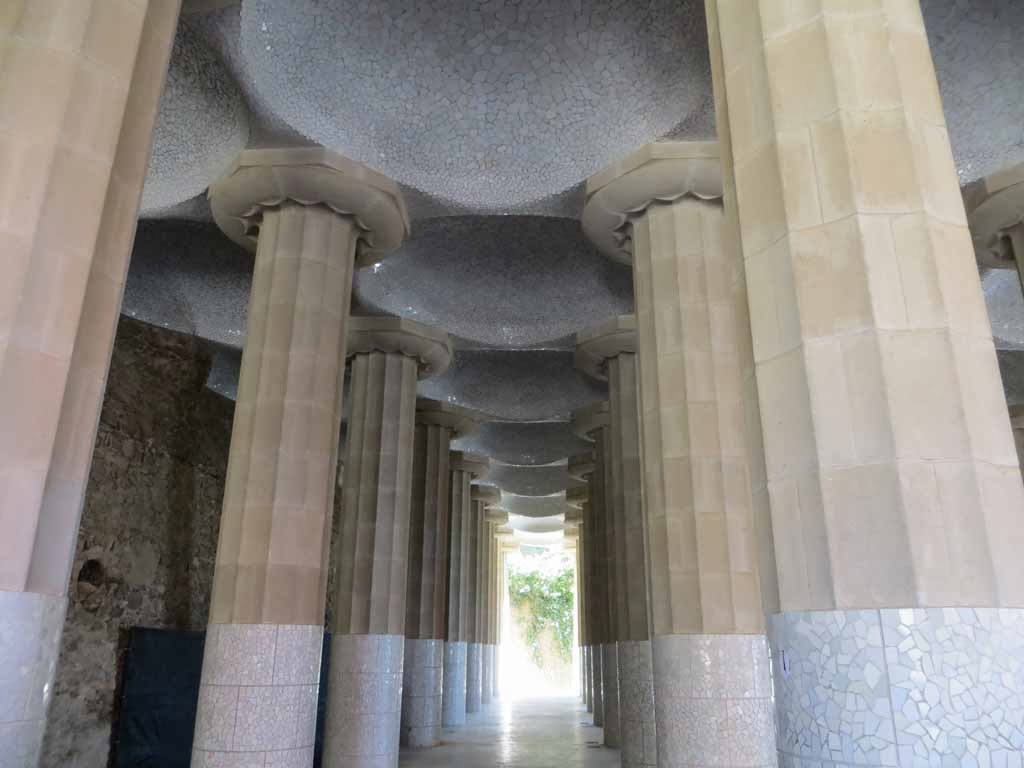


Park Güell started out as a housing development project for Eusebi Güell. From 1900-1914, Gaudí worked on the garden village until it became apparent that the project was a commercial failure. In 1918, Barcelona took over the property and opened it as a public park in 1922.


"Defying labels, Antoni Gaudí's work might be simply called Gaudí-ism."


